Network Automation: What It Is, How It Works & Best Practices
Discover everything about network automation so you can learn how it works, explore tools, automate tasks, and build more reliable networks.


Instead of an engineer logging into devices one by one and repeating the same commands, automation allows a defined process to be executed consistently across multiple devices or environments.
Network automation can range from a simple Python script that collects information from switches to sophisticated workflows that provision devices, validate configurations, detect changes, and automatically respond to network events. Cisco describes it as automating the configuration, management, testing, deployment, and operation of physical and virtual network devices, while Red Hat defines it as using programmable logic to manage network resources and services.
The underlying goal is straightforward: reduce repetitive manual work while making network operations more consistent, scalable, and repeatable.
Introduction
Networks have become too large and dynamic for many repetitive tasks to remain entirely manual.
A network engineer managing a handful of switches may be able to log into each device, make a change, verify the result, and move on. The same approach becomes much harder when an organisation has hundreds of switches, multiple routers, firewalls, cloud environments, different vendors, and frequent configuration changes.
The problem is not simply the amount of work. Manual processes also make it harder to maintain consistency. The same task can be performed slightly differently on different devices, documentation can fall behind the actual configuration, and a small mistake can be repeated across an entire environment.
Network automation addresses this by turning repeatable network tasks into defined workflows.
The 2025 State of Network Automation Survey, which collected 681 responses from 58 countries, shows that most organisations are still somewhere in the middle of their automation journey rather than operating fully automated networks. The reported mean level of automation was 37.45%, with a median of 30%, and 73.19% of respondents reported automation levels at 50% or below.
That makes network automation less of a futuristic concept and more of an ongoing engineering discipline: teams are gradually deciding which parts of network operations should remain manual and which should become repeatable software-driven processes.
Key takeaways
- Network automation uses software and repeatable workflows to reduce manual network operations.
- It can automate configuration, provisioning, backups, monitoring, validation, compliance, troubleshooting, and other lifecycle tasks.
- Python is currently one of the most widely used technologies for network automation, while Ansible, APIs, NETCONF, RESTCONF, and YANG are important parts of the broader ecosystem.
- Automation is not the same as simply generating configuration. Mature automation connects data, logic, validation, execution, and feedback.
- Automation does not remove the need for network engineers. It shifts their work toward design, validation, troubleshooting, orchestration, and building reliable workflows.
- Current adoption is still uneven, which means there is significant room for teams to automate routine work without attempting to automate everything at once.
Why is network automation important?
Traditional network management often depends on engineers interacting directly with infrastructure. They log into devices, run commands, copy configurations, check outputs, update spreadsheets, and document changes.
That process can work for small environments, but it becomes increasingly difficult as networks grow.
Imagine a company needs to create the same VLAN, DHCP configuration, access policy, and monitoring settings across 50 switches. An engineer could manually repeat the process 50 times. Network automation allows the engineer to define the intended change once and use software to apply the appropriate configuration across the environment.
The benefit is not simply speed.
Automation can also improve consistency, repeatability, auditability, and error detection. Red Hat notes that manual configuration can introduce inconsistencies and misconfigurations, while automation can standardise processes and help teams deliver network services at scale.
Automation also changes the economics of engineering time. Engineers can spend less time on repetitive tasks and more time on network design, capacity planning, security, troubleshooting, and projects that require human judgement.
What can be automated in a network?
Network automation can be applied across almost the entire network lifecycle.
| Network task | Example of automation |
|---|---|
| Device provisioning | Automatically configure a new switch or router |
| Configuration deployment | Push approved configuration to multiple devices |
| Configuration backup | Collect and store device configurations automatically |
| Compliance | Compare devices against a defined standard |
| Monitoring | Collect state and performance data automatically |
| Firmware upgrades | Coordinate software updates across devices |
| Service provisioning | Create repeatable network services |
| Validation | Check configurations before or after deployment |
| Troubleshooting | Collect diagnostic information and correlate signals |
| Documentation | Generate records from network data |
| Remediation | Automatically respond to predefined failures |
The 2025 State of Network Automation survey found that configuration deployment was the largest reported area of automation, followed by monitoring and deployment with validation. Backups, device deployment, firmware upgrades, and service provisioning were also among the most commonly automated functions.
Interestingly, the survey also identified a significant gap around troubleshooting, capacity planning, traffic engineering, and firewall rules: these were among the functions respondents said should be automated more than they currently were.
This highlights an important point: the easiest things to automate are not necessarily the only things engineers want automated.
How does network automation work?
At a high level, network automation connects data, logic, communication, execution, and validation.
A typical workflow might look like this:
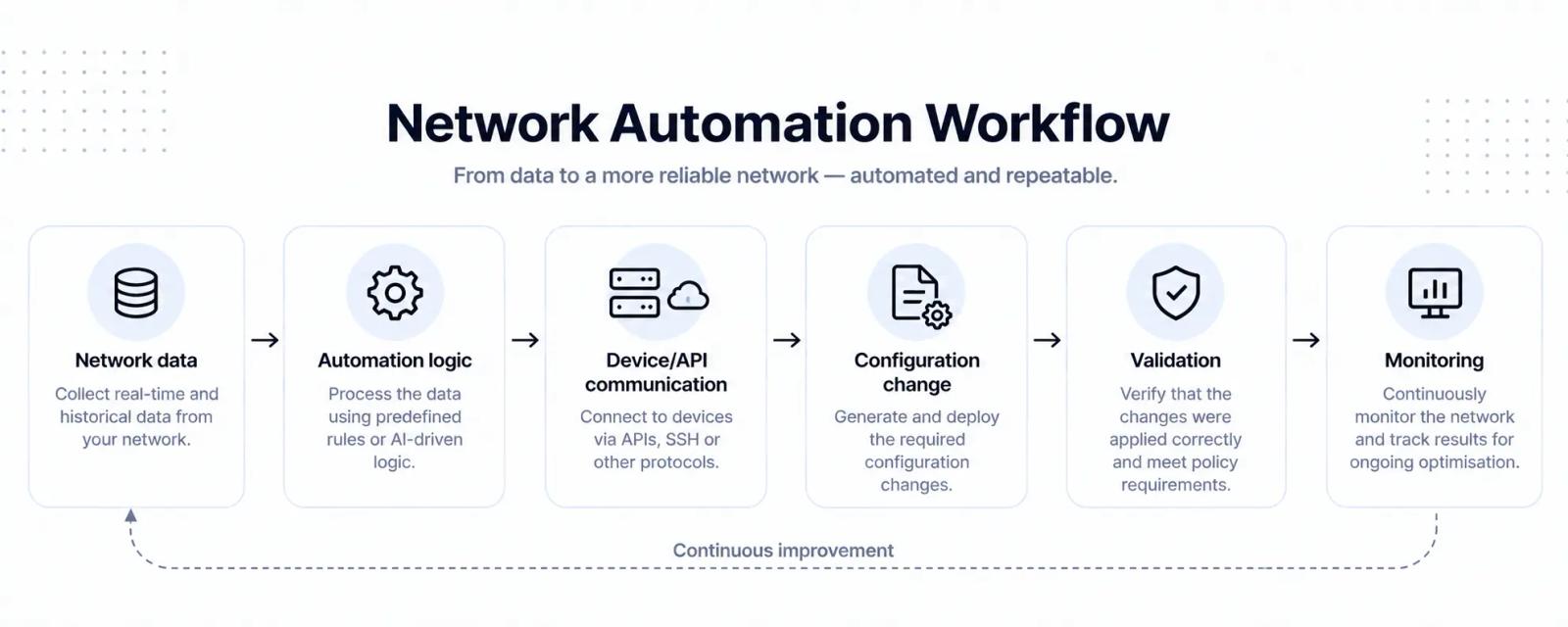
The exact implementation depends on the environment, but the principles are similar.
1. Network data
Automation needs reliable information about the environment. This can include devices, platforms, IP addresses, VLANs, interfaces, credentials, intended configuration, and other network state.
This information may live in an inventory system, source-code repository, database, IPAM platform, controller, or project workspace.
2. Automation logic
The engineer defines what should happen.
This might be a Python script, Ansible playbook, API workflow, Terraform configuration, or another automation mechanism.
The important distinction is between what the network should look like and the specific commands required to achieve that result.
3. Communication
Automation tools need a way to communicate with network infrastructure.
Depending on the platform, this could involve:
- SSH and CLI
- HTTP/HTTPS APIs
- NETCONF
- RESTCONF
- Vendor-specific APIs
- Controllers and management platforms
Ansible's network modules, for example, can communicate with devices through CLI over SSH, NETCONF, or HTTP-based APIs depending on the platform and use case.
4. Execution
The automation engine applies the desired changes to the relevant devices or services.
A well-designed workflow should avoid blindly applying changes. It should know which devices are affected, what the expected state is, and what should happen if something fails.
5. Validation
Validation is one of the most important parts of mature network automation.
After a change, the workflow should be able to determine whether the network reached the expected state. That could involve checking configuration, querying operational state, testing connectivity, or comparing the result against predefined requirements.
This is where network automation becomes more than a faster way to type commands. It becomes a controlled engineering process.
Network automation vs orchestration vs SDN
These terms are often used together, but they describe different concepts.
Network automation refers broadly to using software to automate repeatable network tasks.
Network orchestration goes a step further by coordinating multiple automated tasks, systems, or network domains into one larger workflow. For example, provisioning a service might require changes across switches, firewalls, load balancers, cloud infrastructure, and monitoring systems.
Software-defined networking (SDN) is an architectural approach in which networking behaviour is controlled through software and centralised or programmable control mechanisms. Automation is frequently used within SDN environments, but the terms are not interchangeable.
A simple way to think about the relationship is:
Automation performs tasks → orchestration coordinates tasks → SDN provides a programmable architecture.
That distinction becomes useful when evaluating network automation platforms because a device-level automation script and a multi-domain orchestration system solve different problems.
Network automation and NetDevOps
Network automation is also closely connected to NetDevOps, the application of software-development practices to network operations.
Instead of treating configuration as something that exists only on a device, NetDevOps treats network changes more like software changes: they can be stored in version control, reviewed, tested, validated, and deployed through repeatable processes.
This introduces practices such as:
- Version control with Git
- Configuration as code
- Automated testing
- CI/CD pipelines
- Peer review
- Infrastructure as code
- Structured data models
This approach is particularly useful when networks are changing frequently or when multiple engineers need to collaborate safely.
The broader trend is visible in current industry research. Netaxis, citing the 2025 State of Network Automation Survey, reported that 74% of respondents considered themselves highly skilled in networking compared with 44% in automation, while 91% said network engineers with automation skills were the people building automation in their organisations.
The 2026 Network Automation Survey is currently open, and you can take it here.
The implication is not that network engineers need to become full-time software developers. Rather, modern networking increasingly requires engineers to understand software-based workflows alongside traditional networking fundamentals.
What are the benefits of network automation?
The main benefits of network automation come from making repeatable work consistent and measurable.
Faster operations
A task that takes an engineer 30 minutes per device can become dramatically faster when the same workflow can be executed against multiple devices.
Greater consistency
Automation follows defined instructions instead of relying on an engineer remembering every command or option for every device.
Fewer repetitive errors
Automation does not eliminate errors, but it can reduce errors caused by repeatedly performing the same manual process.
Easier scaling
A workflow that works for 10 devices can often be extended to hundreds or thousands with less additional effort than a fully manual approach.
Better auditability
Automated workflows can record what changed, when it changed, what data was used, and whether validation succeeded.
More engineering capacity
Perhaps the most practical benefit is reclaiming engineering time. Instead of spending hours performing repetitive configuration, engineers can concentrate on architecture, troubleshooting, optimisation, security, and planning.
What are the challenges of network automation?
Automation also introduces new risks.
The most obvious is automating a mistake. A manually misconfigured device affects one place. A poorly designed automation workflow could reproduce the same mistake across an entire network.
This is why validation, testing, access controls, change management, and rollback mechanisms are essential.
Another challenge is complexity. A team can replace a simple manual workflow with an automation system that is so complicated that only one person understands how it works. That creates a new operational dependency instead of removing one.
Vendor differences can also make automation difficult. Different platforms may expose different commands, APIs, data models, and capabilities. A process that works perfectly on one vendor's equipment may need a different implementation elsewhere.
Successful automation therefore requires both engineering knowledge and the ability to design reliable software-driven workflows.
How to start with network automation
For a network engineer who is new to automation, the learning path does not need to begin with a large enterprise platform.
Start with a task you already understand manually.
For example, suppose you regularly need to collect interface status from 30 switches. A simple Python script can connect to those devices and gather the required information into a structured result.
Once that works, the next step might be generating configurations from structured data. Then introduce validation. From there, you can move toward Ansible playbooks, APIs, Git, testing, and larger automated workflows.
This progression is important because the networking knowledge comes first. Automation should encode a process the engineer already understands rather than becoming an excuse to avoid understanding what the network is doing.
A practical progression looks like:

That is often more sustainable than trying to build a complete NetDevOps platform from day one.
The role of AI in network automation
AI is becoming part of the network automation conversation, but it is important to distinguish AI-assisted automation from traditional deterministic automation.
Traditional automation follows explicitly defined logic. If a condition occurs, execute a known action.
AI-based systems can assist with tasks that require interpretation, such as summarising network state, generating automation code, analysing large amounts of telemetry, finding unusual patterns, or helping engineers investigate incidents.
HPE describes AI-assisted network automation as including predictive insights, recommendations, intent-based networking, and interactive workflows for tasks such as documentation retrieval, impact assessment, and troubleshooting.
At the same time, the 2025 State of Network Automation Survey showed that production use of LLMs within surveyed network environments was still limited at that time: 3.04% reported LLMs deployed with access to production network data or systems, while 13.5% were in development or testing and 34.03% were considering or exploring the technology.
That suggests the near-term role of AI is likely to complement deterministic automation rather than simply replace it.
In 2026, Gartner lists agentic NetOps software among its five highlighted enterprise networking trends, showing that autonomous and AI-assisted network operations are becoming a recognised area of industry attention.
For network engineers, the important distinction remains human control over production changes. AI can help create, explain, analyse, or suggest actions, but network-specific validation and review remain important before changes reach production.
Where NetField fits into network automation
Network automation is often described as if the difficult part is simply sending commands to devices.
In practice, the work before execution matters just as much.
An automation workflow still needs accurate network data, a clear addressing plan, device information, a defined intent, generated configuration, validation, and documentation. If those inputs are inconsistent, automating the execution step simply allows the inconsistency to move faster.
This is where NetField fits into the broader network automation workflow.
NetField is designed as a network-engineering project workspace for planning, building, validating, and documenting network projects. Its current workflow keeps network basics, devices, addressing, and outputs connected, while configuration can be generated for multiple platforms including Cisco IOS, NX-OS, Juniper, MikroTik, Aruba, Fortinet, and Ubiquiti.
That makes NetField complementary to automation tools rather than a replacement for every automation engine.
For example, an engineer might use NetField to define the network intent and addressing, generate platform-specific configuration, validate the configuration for issues such as duplicate IPs, missing VLAN definitions, or overlapping subnets, and then use the approved output within the organisation's existing deployment or automation process.
NetField’s generated configuration is a starting point for review, not a substitute for review.
This distinction is important.
Automation is only as reliable as the data and logic behind it.
NetField is especially relevant to the stages before and around execution, where network engineers need a consistent project context rather than disconnected spreadsheets, terminal sessions, configuration files, and documentation.
The product itself was created around this problem: NetField describes its purpose as helping engineers keep the network project together, from planning and addressing through configuration generation, validation, and documentation.
The future of network automation
The direction of networking is increasingly clear: infrastructure is becoming more programmable, more data-driven, and more closely connected to software practices.
Traditional CLI skills remain important, but network engineers are increasingly working with APIs, structured data, automation frameworks, cloud platforms, telemetry, Git, and software-based workflows.
The 2025 survey shows that the industry is not yet at a point where everything is automated. Most respondents were still operating below 50% automation, and many organisations had no dedicated automation staff.
That may actually be the most useful insight for engineers. Network automation is not a switch that organisations simply turn on. It is a gradual transition in which teams identify repetitive work, standardise it, introduce validation, automate it, measure the result, and then expand into more complex use cases.
The future is therefore less about removing engineers from the network and more about giving engineers better tools to manage increasingly complex infrastructure.
Conclusion
Network automation is the use of software and repeatable workflows to make network operations more consistent, scalable, and less dependent on manual intervention.
It can automate everything from configuration backups and device provisioning to monitoring, compliance, validation, service deployment, and eventually more advanced remediation workflows.
The technology behind it ranges from Python and Ansible to APIs, NETCONF, RESTCONF, YANG, controllers, infrastructure-as-code tools, and increasingly AI-assisted systems. But the technology is only one part of the equation. Good automation also requires reliable data, clear intent, testing, validation, documentation, and engineers who understand the network being automated.
The 2025 State of Network Automation Survey shows that most organisations are still progressing through this journey rather than operating completely automated networks. That leaves plenty of room for practical improvements, especially around the repetitive tasks that consume engineering time.
For network teams, the most useful approach is usually not to automate everything at once. It is to make repeatable engineering work structured, validated, and easier to execute consistently.
That is also where NetField fits into the picture: helping network engineers keep the planning, addressing, configuration generation, validation, and documentation connected so automation has a cleaner foundation to work from.
Automate the repetitive work. Keep engineering decisions in control.
FAQ
What are some examples of network automation?
Common examples include automated configuration deployment, device provisioning, configuration backups, firmware upgrades, compliance checks, monitoring, service provisioning, configuration validation, and automated troubleshooting workflows.
What is the most common language for network automation?
Python is currently one of the most widely used languages for network automation. In the 2025 State of Network Automation Survey, Python accounted for 92.95% of the scripting-language mentions reported by respondents.
Is Ansible used for network automation?
Yes. Ansible provides network-specific modules and collections for automating devices from multiple vendors and can communicate using methods such as CLI over SSH, NETCONF, and HTTP-based APIs depending on the platform.
Does network automation replace network engineers?
Automation reduces repetitive manual work, but it does not remove the need for network engineering knowledge. Engineers still need to design networks, define intended states, validate changes, troubleshoot unexpected behaviour, and manage exceptions.
What are NETCONF and RESTCONF?
NETCONF and RESTCONF are network management protocols used with YANG-modeled data. They provide structured ways to configure and retrieve network information instead of relying exclusively on device-specific CLI commands.
How does AI fit into network automation?
AI can assist with areas such as troubleshooting, documentation, network analysis, code generation, anomaly detection, and intent-based operations. Deterministic automation remains important for repeatable production changes, while AI can increasingly assist engineers with analysis and decision support. Current adoption is still developing across network teams.
